(UN)COMMONS: PUBLIC PROGRAMME
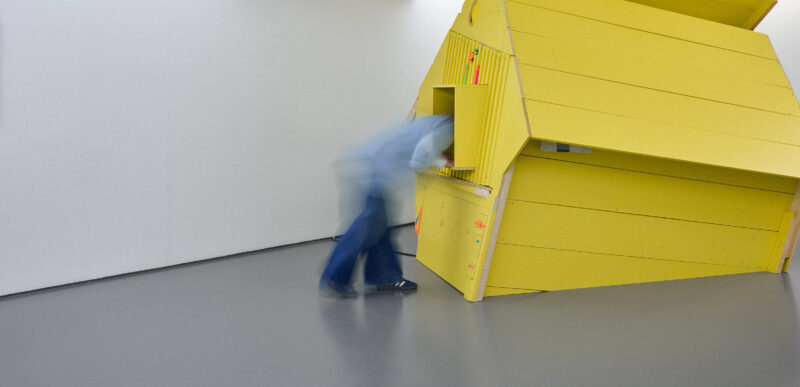
(UN)COMMONS: towards an institution otherwise approaches access as a creative, political, and aesthetic methodology. The public program extends this inquiry outward, inviting practitioners to expand, contest, and respond to the questions the exhibition opens.
The program unfolds through a series of interconnected questions: How do disabled and neurodivergent bodies appear through lens-based practices, and what do images make possible in that encounter? How do physical barriers within cultural infrastructures relate to deeper institutional ones? What role does accessibility play in our memory of historical events, and who gets to see, interpret, and remember? How can archival and lens-based research make visible the collective histories of disabled, trans, queer, and other dispossessed communities? These questions are explored through screenings, conversations, guided visits, and workshops.
The program also introduces activities that run throughout our exhibition program. Scaffolding, a series of critical writing workshops hosted by artists and writers, offers tools for thinking through access, ableism, and disability justice in relation to image-making. Mediated visits invite shared encounters with the exhibition through formats such as collective discussion and mapping, creating specific entry points for different publics.
The public program is part of Fotogalleriet’s ongoing commitment to think about and with images, and was curated by Belén Santillán.
This program is supported by Fritt Ord and the Master in Medium and Material-Based Art (MAMBA) at the Art and Craft Department, Kunsthøgskolen i Oslo (KHiO).


Screening and conversation
How can lens-based practices explore and represent neurodivergent experiences within institutional settings? Finnish visual artist Inari Sandell works through personal and research-driven engagement with themes of neurodiversity, examining how images and spaces construct, and constrain, ways of being. The session opens with a screening of Sandell’s film Total Control (2025, 7’34”), followed by a conversation with Aidan Moesby, a disabled and neurodivergent artist, curator, and writer whose practice explores the interconnections between climate change and natural and social environments.
Together, Sandell and Moesby reflect on what it means to navigate institutional logic as a neurodivergent practitioner and how lens-based work can make those experiences visible, legible, and contested.
Inari Sandell is a Helsinki-based visual artist working across images, space, and material in a multidisciplinary practice. Central to their work is a personal, research-driven engagement with themes of neurodiversity. Sandell holds an MFA from Uniarts Helsinki’s Academy of Fine Arts (2023). Their work has been exhibited internationally at institutions including Fundació Joan Miró (Barcelona), UKS (Oslo), Hafnarborg Centre of Culture and Fine Art (Hafnarfjörður), the Finnish Cultural Institute in New York, HAM Helsinki Art Museum, and Titanik (Turku).
Aidan Moesby is a disabled and neurodivergent artist, curator, and writer whose practice explores climate change and the interconnection between natural and social environments. Grounded in care and accessibility, his work spans Disability Arts and mainstream contexts across physical and digital platforms. His projects often begin as catalysts for discussion and public programming, engaging non-art audiences and fostering cross-disciplinary exchange to support positive social change. As a curator, he explores themes including identity, loneliness, and connectivity through a disability and intersectional lens, with access and inclusion central to his exhibition design. This approach also informs his work as a Cultural Access Consultant, supporting organizations in developing and implementing strategies for diversity and equity.
Guided visit with Hedevig Anker
What conditions make lens-based practices possible and for whom? Join photographer and art historian Hedevig Anker and curator Randi Midthun for a guided visit through (UN)COMMONS: towards an institution otherwise.
The visit brings findings from Fotogalleriet’s recent accessibility study into dialogue with the exhibition’s curatorial framework, tracing how questions of access intersect with the structural logics that shape what bodies can enter, participate in, and be represented through photographic and lens-based practices.
Together, Anker and Midthun reflect on how the gallery space itself conditions the production and reception of image-based art, and what it might mean to practice otherwise.
Hedevig Anker is educated as a visual artist from Kunsthøgskolen i Oslo and as an art historian from Universitetet i Bergen. She has held several solo exhibitions at museums such as Lillehammer Kunstmuseum and Stenersenmuseet in Oslo, as well as at galleries across the country, including Kunstnerforbundet. Her work has also been presented in major group exhibitions such as Høstutstillingen, Østlandsutstillingen, and Norske Fagfotografers Forbunds Vårutstilling. In recent years, she has continued to develop her practice through exhibitions such as A light in a Surface at Galleri Brandstrup (Oslo, 2023) and group presentations at Nitja senter for samtidskunst, as well as upcoming projects including a solo exhibition at Sandefjord kunstforening (2025).
Book Launch: Curating & Repair
Curating & Repair is a publication exploring contemporary curatorial practices and exhibition-making as contexts for dialogue, exchange and the remaking of social and cultural relations through repair. It seeks actionable insights into how artistic work, its mediation and the institutions that support it might be mobilised toward more sustainable and interdependent worlds.
The publication is a result of a three-year, collaborative project, Out of the Metropolis-Art Exchange Across Borders. The project is initiated by NŌUA (Bodø, Norway), Double Dummy (Arles, France) and The Finnish Museum of Photography (Helsinki, Finland).
The publication is supported by Creative Europe, Arts Council Norway and Fritt Ord.
Recuperating the Antifascist Memories through Accessibility
What if accessibility could be a form of memory-keeping? Saša Asentić brings together participatory artistic research and innovative approaches to visual access, including drawings, photographs, and image descriptions, to document acts of solidarity in Norwegian forced labor camps during World War II.
Remote memorial sites like Øvre Jernvann are recovered as public space, and the histories of antifascist resistance held there are made available to wider and more diverse audiences. The presentation shares research materials and opens a conversation about methodology, future directions, and what it means to place accessibility at the heart of both artistic practice and historical justice. After the presentation, Saša Asentić will be in conversation with Michael Stokke, PhD in History.
The project is developed in partnership with Narvik War Museum and Narvik Peace and War Center, with support from KORO – Kunst i offentlige rom.
Saša Asentić (b. 1977, Derventa, Bosnia and Herzegovina, former Yugoslavia) is a non-disabled choreographer, researcher, and cultural worker, based in Oslo. Asentić works within contemporary dance, performance, and disability arts. His artistic practice is grounded in principles of solidarity and resistance to cultural oppression and indoctrination. Community and long-term collaborations play a crucial role in his work. Since 2007, his artistic work has been presented internationally on major stages and at performing arts festivals, including in Berlin, New York, Paris, Tokyo, Vienna, Tehran, Athens, and Moscow. Asentić is the initiator of the organization Per.Art, which since 1999 has brought together a group of disabled and non-disabled artists, challenging and counteracting ableism in dance and culture. He is currently a PhD fellow at the Oslo National Academy of the Arts.
Michael Stokke researches all prison history in Norway. This includes both Soviet and Polish prisoners of war and Yugoslav prisoners, but also civilian forced laborers from the same area and from other parts of Europe.
Open cafe with Fergus
Artist Fergus Tibbs will be running his café installation at the gallery, serving snacks and drinks. Everyone is welcome to come by, say hi, have a chat, and grab a bite to eat. Drop in anytime between 12:00 and 17:00.
Fergus Tibbs is an artist, DJ, and cultural producer from Glasgow, Scotland, based in Bergen, Norway. His practice explores how people gather, how bodies occupy and shape space, and how individuals interact in shared environments, often creating situations that encourage conversation and public dialogue through oral and in-person exchange. Over the past decade, he has been DJing and organising parties, and is the co-founder of Keep it Dark, a club night at Østre in Bergen that functions as a test site for spatial, sensory, and social experimentation. His broader practice includes projects such as radio stations, swimming clubs, exhibitions, and workshops. Hosting is central to his work, and through his ongoing project Hosting Infrastructure, he develops structures and environments for gathering, creating flexible settings for sitting, eating, performing, dancing, and conversation in a playful, open, and accessible way.
Workshop: Access Riders for ending Ableist White Supremacy
Access Riders are written documents used by artists and designers coming from Disability communities to outline our access needs—to describe what we need to be fully in a space, whether online or on-site. These may include changes to practices such as snacks, break times, an understanding of what is a “normal” length of time to wait for an email response, and implementing physical or social transformations to the space. Access needs can change depending on fluctuations of someone’s hormonal cycle, a flare-up from a chronic illness, a personal trigger from past trauma, or even how well they slept the night before. Everyone has access needs, some of which are normalized—for instance, the practice of wearing glasses, or taking written notes to be able to better remember something. And there are the access needs that—as a result of unequal power relations—are not yet cared for. In this workshop we will learn about what Access Riders are, make some of our own and discuss how to unmake Ableist White Supremacy.
Talk: Coalition Storytelling: on need
In this talk Ren Loren Britton will speak through their research line emerging from their studio practice Coalition Storytelling. Coalition Storytelling reaches into the transcrip his- her- hir-storical archive to seek out stories of when coalitions between Disabled, trans*, queer and other dispossessed groups has gone well. This lecture moves with the explicit desire to resource our political imaginaries with experiences of when our needs have been met, well and together – pluralizing possibilities of how and what to collaborate on. Moving with the aesthetics of access three works emerging out of this research line will be shared: Coalition Bouquet: 504 Sit-In, Coalition Constellation: Constellating Reparations and Das Märchen von den verkrüppelten Blättern / Real Life with the Crippled Leaves. You are invited to join this lecture in all forms: online, onsite, asyncronously and with lovers & friends. There will be a Q&A at the end and getting gentile instead of getting forceful will be welcomed.
Ren Loren Britton is a trans*disciplinary artist-designer who reverberates with trans*feminism, technosciences, radical pedagogy and disability justice. Trans*feminist technoscience in their work follows the long wiggle of cyberfeminism; focusing on trans*, as in, transgender and trans*, as in, crossing contexts with feminist concerns. They are interested in the ways that socio technical systems & media makes lives accessible and pleasurable. Departing from the understanding that we live in a deeply ableist white supremacist world, and therefore to be able to follow a justice oriented direction, their work begins from the assumption that we must rethink the terms of who fits into institutions of all scales, with what friction (or not) and why. This set of considerations brings them to their interest in disability justice which upholds and values all non-normative bodies and minds. In this way their artistic research is often collaborative, focuses on reaching their named community (trans*gender and disabled people) and focuses on the critical technologies, narratives and media practices that have connected us in our shared non-linear futures, pasts and presents. This conceptual framework enables their practice often engaging hir-her-historical storytelling looking into under-attended to narratives that tell other stories about technologies, counter-pathologies and community connection.
Ren Loren Britton’s participation is made possible through the support of Medium and Material-Based Art (MAMBA), Art and Craft Department, Kunsthøgskolen i Oslo (KHiO).