(UN)COMMONS: towards an institution otherwise
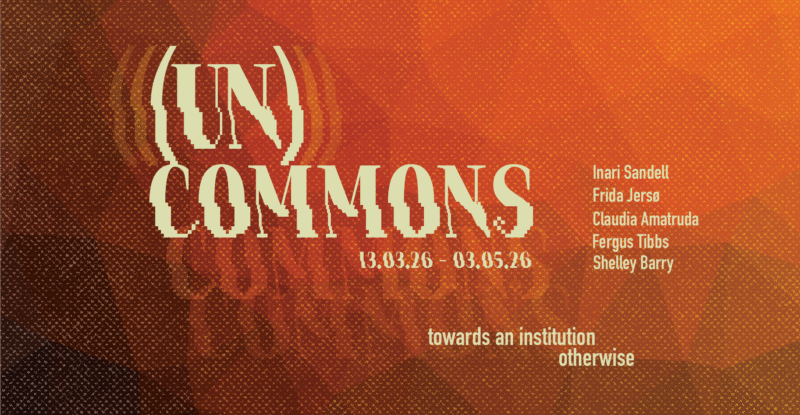
(UN)COMMONS: towards an institution otherwise is an exhibition that asks how an art institution might be reimagined from within. Developed through a year of inquiry into access, labour, spatial politics, and structural inclusion, the project considers the gallery not as a neutral container, but as a site shaped by power, habit, and possibility.
Bringing together participating artists whose practices engage questions of visibility, care, vulnerability, refusal, and collective authorship, the exhibition foregrounds the conditions that enable cultural production. Their works attend to infrastructures: social, architectural, and bureaucratic, and insist that artistic practice is conditioned (and often constrained) by the institutional logics that frame it.
The exhibition forms part of an ongoing process within the institution: to move beyond compliance toward accountability, beyond representation toward structural change. Accompanied by a public programme of conversations, workshops, and shared study, (UN)COMMONS proposes the gallery as a testing ground; a space where institutional habits can be examined, unsettled, and practised otherwise.
Participating Artists


Frida Lisa Carstensen Jersø is a visual artist educated in Fine Art Photography at HDK-Valand in Gothenburg. She works with photography as an expanded and interdisciplinary medium, moving between analogue and digital photography, sculpture, 3D printing, and medical imaging material. Her practice is long-term and process-based, unfolding over several years.
Through her work, she investigates the relationship between image and body across surface, volume, and space. At the core of her practice is an examination of the body as a cultural and visual construction, with a particular focus on the disabled body. She explores how medical, social, and visual systems shape notions of functionality, and how images can foster more nuanced and inclusive understandings of embodiment while encouraging critical reflection on ableism.
A central concern in her work is the violence enacted upon disabled bodies—not necessarily as physical harm, but as systemic pressure and continuous regulation. This violence is experienced through healthcare systems, public administration, and legislation, and manifests through structural decisions that shape lives via assessments, conditions, and restricted access to support. Through her practice, she seeks to create genuine space for the disabled body within the realm of art and to increase awareness of the power structures that define and regulate bodily existence.
Inari Sandell (b. 1991) is a Helsinki-based visual artist who works with image, space and material in a multidisciplinary way. Central to their practice is a personal and research-based engagement with themes related to neurodiversity. Sandell graduated with a Master of Fine Arts (MFA) degree from Uniarts Helsinki’s Academy of Fine Arts in 2023. Their work has been exhibited internationally at a variety of museums and galleries, including Fundació Joan Miró in Barcelona, UKS in Oslo, Hafnarborg Centre of Culture and Fine Art in Hafnarfjörður, the Finnish Cultural Institute in New York, HAM Helsinki Art Museum, and Titanik in Turku.
Fergus Tibbs is an artist, DJ, and cultural producer from Glasgow, Scotland, now based in Bergen, Norway.
Fergus’ practice explores how people gather together—how bodies occupy and shape space, and how individuals interact with one another when gathered. Central to his work is oral communication and in person human interaction, often creating situations that encourage conversations and public dialogue. His previous projects include club nights, radio stations, a swimming club, parties, exhibitions, pubs, and workshops.
For the past ten years, he has been DJing and organising parties. He is the co-founder and organiser of Keep it Dark, a club night in Bergen held at Østre. He uses this regular party as a test site for new ideas, often playing with the physical space as well as light, sound, temperature and ritual as well as curating an invited artist programme.
Hosting has become a key part of Fergus’ work, providing a way to experiment with interactions and gatherings. His ongoing project, Hosting Infrastructure, plays with the architecture and objects needed when gathering people. He creates structures and environments that serve as a substrate for public events, where people can sit, gather, eat, perform, dance, or talk. His approach is fun, often silly, and welcoming whilst always trying to be accessible, hoping to draw in people with a broad range of perspectives.
He holds an MFA from The Art Academy Bergen (KMD) and a BA (Hons) from DJCAD, Dundee.
Claudia Amatruda (1995, Foggia, IT) is a visual artist working across photography, video, sculpture, and installation. She investigates the body as a site of resistance, transformation, and possible evolution. Rooted in a lived experience of disability, her practice explores continuities between the human, the posthuman, and the environment. Water plays a central role in her work: origin, device of care, and connective force linking human life, marine mammals, and fossil traces of extinct creatures. In 2026 she presents the solo exhibition A body engineered by water at Fondazione Carlo Gajani during ART CITY Bologna. In 2025 she holds a solo exhibition at the Istituto Italiano di Cultura di Stoccolma, following the “Nuove Traiettorie” special mention of the Premio Luigi Ghirri within Fotografia Europea 2024. The same year, she was selected by Fotografia for FUTURES Photography and received CAMERA – Centro Italiano per la the Premio Banca di Bologna in collaboration with PhMuseum. Her work has been featured in Artribune (2026), Exibart (2025), Il Giornale dell’Arte (2023), and C41 Magazine (2023). An artist book will be published by RVM Hub in 2026.
Born and raised in the Eastern Cape, South Africa, Barry completed graduate studies in English and Drama at the University of Cape Town and University of the Western Cape. She has worked extensively as a disability rights activist, following a shooting in the taxi wars of 1996 that resulted in her using a wheelchair.
Acknowledgements
The public programme for (UN)COMMONS is generously funded by Fritt Ord.
For press inquiries contact:
ana@fotogalleriet.no
For booking mediation tours contact:
belen@fotogalleriet.no


